The High Court has ruled that kettling tactics at the G20 protests in 2009 was illegal. But the Police say that kettling "is a necessary tactic to tackle the potential for violence".
Potential is an interesting word. Crowd control is a fine line between structure and chaos.
But that line isn't one created or maintained by the Police. It's one that manifests through trust.
Public demonstration is inherently problematic - if an issue has reached this stage, then there's already a lot of anger around. A lot of people who feel like they haven't been listened to. Of course the potential for violence exists in a demonstration - "successful" politics avoids all physical confrontation, walking or fighting.
A demonstration is a final call to be listened to - but more than that. It's a final show of order and solidarity, a challenge for the ruling parties to trust this potential. If the Police - as the on-the-ground representation of the parties - cannot display this trust, and actively suppress this physical demonstration, then of course anger will turn violent.
Thursday, April 14, 2011


Wednesday, April 06, 2011
How do you network yours? (Why the medium is not the message.)
Even co-operation is in competition, it seems. Social media has sprung up all over the place, and even those that "get it" are feeling fairly confused. Should we set up a new conversation, or find an existing one? Should we post our thoughts to Facebook or to a blog? Should we be broadcasting or engaging?
For some people, the answers to these will be "obvious". But often what we think is obvious is actually just what's lacking - what we're arguing for more of.
Really, the answer is that there is no answer. Sometimes broadcasting is useful, sometimes listening is useful. Sometimes blogs are fine, sometimes Facebook is fine. It depends. It matters. And yet at the same time, it doesn't matter. Conversation is more than a blog post or what-have-you, because conversation is about ideas - and good ideas will spread across networks, across media.
Stepping back a moment, Louise Kidney does a great job of picking up on digital inclusion/exclusion within existing groups, and takes a practical line of engaging people with the communication tools they need in the modern world.
I think this is vital. It's ridiculous to think that our democracy is limited to pre-defined routes of communication. Imagine if you couldn't phone a council because they were afraid of misusing the telephone. Imagine if you couldn't e-mail them because they weren't sure whether to say "Hi" or "Dear Sir".
But at the same time, I think we need to look beyond this. (Hey, I like big ideas.) We need to look under the hood and ask why there seems to be a continual mismatch between the tools being used by citizens, and the tools being used by authorities. Can we really afford to re-assess every new website as it forms? Following on from that, should all forms of communication be used to engage with citizens? And if not, which ones should be? When should support for old networks get killed off?
(I don't have answers for these. What I do have is a different way of approaching the situation, rather than going in circles. I'm a geek. I abstracterise things. Big ideas come out somewhere along the line. Sometimes these make things clearer. Sometimes not.)
In my mind, the "problem" is not, fundamentally, one of tools - but of how and why we organise ourselves.
Go and read this article on Scotland's social media efforts. Go on. I'll wait.
Now notice - the strapline there mentions social media. The article mentions Twitter and Facebook a couple of times. But really, the core point of it, is not what people are using, but who is doing it, and how. Social media are just one way this manifests.
But the tools are ephemeral. In the real world, groups form around issues, and tools form around groups. Not the other way around. I use many websites and I even go to a few face-to-face meetings. But, largely speaking, the networks are the same across all of these. Sometimes bits of these networks use tools I don't use (e.g. Tumblr) but that's fine - I participate using the tools I find most useful (e.g. Beer).
Learning how to use a tool/interface is useful, but it's not essential. True engagement happens whatever the tool - it comes from getting involved, turning up to meetings, listening to people, feeding back, taking things seriously, having fun.
And I think it's this level of engagement that people are struggling with - new social rules, not new interfaces. People are afraid of turning up to workshops or pubs in the same way they're afraid of using new websites, but if we're to make something that benefits everyone, we have to work out what methods and, more importantly, what networks suit each person best. (That's one to return to in a different post, though.)
For some people, the answers to these will be "obvious". But often what we think is obvious is actually just what's lacking - what we're arguing for more of.
Really, the answer is that there is no answer. Sometimes broadcasting is useful, sometimes listening is useful. Sometimes blogs are fine, sometimes Facebook is fine. It depends. It matters. And yet at the same time, it doesn't matter. Conversation is more than a blog post or what-have-you, because conversation is about ideas - and good ideas will spread across networks, across media.
Stepping back a moment, Louise Kidney does a great job of picking up on digital inclusion/exclusion within existing groups, and takes a practical line of engaging people with the communication tools they need in the modern world.
I think this is vital. It's ridiculous to think that our democracy is limited to pre-defined routes of communication. Imagine if you couldn't phone a council because they were afraid of misusing the telephone. Imagine if you couldn't e-mail them because they weren't sure whether to say "Hi" or "Dear Sir".
But at the same time, I think we need to look beyond this. (Hey, I like big ideas.) We need to look under the hood and ask why there seems to be a continual mismatch between the tools being used by citizens, and the tools being used by authorities. Can we really afford to re-assess every new website as it forms? Following on from that, should all forms of communication be used to engage with citizens? And if not, which ones should be? When should support for old networks get killed off?
(I don't have answers for these. What I do have is a different way of approaching the situation, rather than going in circles. I'm a geek. I abstracterise things. Big ideas come out somewhere along the line. Sometimes these make things clearer. Sometimes not.)
In my mind, the "problem" is not, fundamentally, one of tools - but of how and why we organise ourselves.
Go and read this article on Scotland's social media efforts. Go on. I'll wait.
Now notice - the strapline there mentions social media. The article mentions Twitter and Facebook a couple of times. But really, the core point of it, is not what people are using, but who is doing it, and how. Social media are just one way this manifests.
But the tools are ephemeral. In the real world, groups form around issues, and tools form around groups. Not the other way around. I use many websites and I even go to a few face-to-face meetings. But, largely speaking, the networks are the same across all of these. Sometimes bits of these networks use tools I don't use (e.g. Tumblr) but that's fine - I participate using the tools I find most useful (e.g. Beer).
Learning how to use a tool/interface is useful, but it's not essential. True engagement happens whatever the tool - it comes from getting involved, turning up to meetings, listening to people, feeding back, taking things seriously, having fun.
And I think it's this level of engagement that people are struggling with - new social rules, not new interfaces. People are afraid of turning up to workshops or pubs in the same way they're afraid of using new websites, but if we're to make something that benefits everyone, we have to work out what methods and, more importantly, what networks suit each person best. (That's one to return to in a different post, though.)
Monday, February 14, 2011
Hackers, transparency, and the zen of failure

This week I picked up the Hacker Ethic from my library (remember them?) by Pekka Himanen, with an intro by Linus Torvalds and an outro by Manuel Castells. It was hard to resist it with names like that splashed across it.
The book was written in 2001, back when the browser wars were in full swing and streamed video was still a bit of a novelty (so nothing's changed that much). But the theme addressed by Himanen is anything but dated - and contains some key threads which I want to think about and blog about more.
A lot of the text deals with the idea of what makes a "hacker" tick -and not just geek hackers, but anyone with a passion for what they do, rather than a bitter feeling that they work because they have to. Central to this hackerness is a passionate creativity, and a desire to share knowledge - including the results of that knowledge, such as code.
The truth and untruth of progress
This act of sharing knowledge is partially a form of status, true. But when you read articles like this about incorrect data being published, you start to notice what else open knowledge (including data) is about - social learning.
Hackers and open government are both (now) keen on sharing data - knowledge, code, ideas. But the real difference is in how they learn - for the hacker, openness brings about learning and improvement through public failure - there is an assumption that what you create can be improved, and an attitude that anyone else is welcome to improve it.
Now compare this to CLG's response to the LGC article above - a response filled with defensive language and finger-pointing. There is something rather scientific - or, rather, legal - about this discourse: claims are made by one party and refuted by another. Slowly the "truth" is "sculpted" from what is left.
But for the hacker, the truth is only what is created - not what is undisputed. Hackers fork code, create new communities, start new websites, run unconferences. If "truth" exists, then it is what emerges, not what is discovered, or what remains.
What do hackers sit on?
Can a highly hierarchical structure such as our democracy adapt to be creative rather than competitive? The open data movement is driven by both of these - data for transparency can be thought of as "evidence" in a legal bid for the justification of an organisation's existence. Data for new apps, on the other hand, only needs a use, and to be useful in a creative context.
This split in attitude is key when considering efforts like the recent consultation on local data transparency, which clearly puts "open data" into the evidential context:
The Government wants to place more power into people’s hands to increase transparency by seeing how their money is spent.
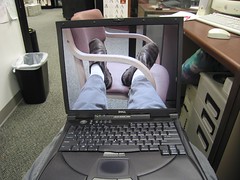
img by AMagill
To return to this post's title, what role will failure and learning play in this paradox? Looking at the draft code, we can see a desire to use the "many eyes" approach to fixing data:
18. Data should be as accurate as possible at first publication. While errors may occur the publication of information should not be unduly delayed to rectify mistakes. Instead, publication and use of the data should be used to help address any imperfections and deficiencies.
The hacker approach agrees with this - fix things as we go along. But does this fit with the idea of "armchair auditors"? As we saw in the LGC article, how can an auditor tell the difference between what is incorrect, and what is wholely disagreeable? And if they can't, why should they trust any of it?
(Maybe we need a "stable release" system like that of open source projects? Maybe, like the Linux kernel or desktop distributions, data can be released with an "unstable/testing" tag, then marked up as "stable/trustable" after enough testing has been done on it.)
Transparency is a lovely thing - but everyone has different uses for it. If it's used for creativity, then there is, perhaps, an implicit assumption that things can and will change. If, on the other hand it's to be used for accountability, then there needs to be trust in it.
Tuesday, February 08, 2011
GovFiction: The Beast Made Transparent
Richard picked up the flaming Torch of Transparency and held it in front of him.
"I can see it," he whispered. "I can see everything."
The creature lay before him, barely breathing. Its belly was half-open, but Richard couldn't tell which parts had been clawed apart by an unknown swarm, and which had been torn open by the creature itself. Quick, but deep cuts littered the remaining flesh, but it was clear that most of the creature's lifeblood had leaked away long before.
Richard looked on guiltily - he couldn't suppress a faint sense of pity for this beast which for so long had had so much control over him. He felt a sense of anti-climax - a romantic desire that such a mighty being should meet its demise in some proud battle, rather than like this. Rather than in dark obscurity.
With slow, steady breaths, he put out the flame, and headed back towards the surface. Somewhere, there was still daylight.
Sunday, January 23, 2011
#UKGC11: Hooking into DIY Data
Following on from data relativity, the second thing that grabbed me at #ukgc11 (UKGovCamp 2011) happened during Will Perrin’s introduction to “Making a Difference with Data”, and followed up in conversation with Helen Jeffrey (@imhelenj) on community-led data. Will talked of comparing his local authorities’ data on lamp-post repair time to his own count for how long a lamp-post had been broken for (encouraging crime). Helen talked about data that a group of volunteers had collected themselves, and then turned into a report to feed into government decision-making.
In both cases, what struck me was that people don’t have such an aversion or fear of data that is often assumed - if they start by generating it themselves.
To go back to data relativity, the most confusing and scary part of data is figuring out the thought processes and assumptions that have gone into a dataset, as well as figuring out what the hell’s important (often around 0.01%-0.5% of the data) and what’s “noise” - to an individual. Self-generated data doesn’t suffer from this, because all the scary background and assumption bits are part of the citizen’s/volunteer’s mindset and experience. Voila, understanding data comes from experience. And as such, successful engagement with data is about creation as well as consumption.
OK, it’s clearly a little more complicated than that, but it’s a principle that’s often far too implicit for some datasets (crowdsourced maps, etc), and far too often forgotten about for others (most centrally-gathered stats). There are also a whole bunch of stereotypes about what “people” “want” from “data”, and often these stereotypes do little except re-establish the status quo. When data comes up against real-world users (yes, even geeks), and the magic “fails to happen”, we’re left wondering if natural engagement is such a given after all.
It’s difficult to get excited about thousands of datasets when you have no idea where to start or where they can be relevant to you. It’s much, much easier to get excited about data that is relevant to to you, that you understand, and that you can see how it will benefit you. I think that’s why I love the idea of Mappiness or Christian Nold’s maps - both involve getting people to create data they find interesting, and through this “personal” data, the need and relevance for other data suddenly becomes instant and appreciated. (For example, if I’m feeling most happy on street X, what other properties does that street have, and how do they relate to me - house prices? Pollution? Streetworks?)
This seems to be an issue that is bubbling along - everyone knows that organisations collect data, for instance, so an open data system worth its salt will take that into account. But there are still assumptions about the scale and complexity of that data, I would argue - whereas really, data can be as simple as counting, and everyone can count.
In both cases, what struck me was that people don’t have such an aversion or fear of data that is often assumed - if they start by generating it themselves.
To go back to data relativity, the most confusing and scary part of data is figuring out the thought processes and assumptions that have gone into a dataset, as well as figuring out what the hell’s important (often around 0.01%-0.5% of the data) and what’s “noise” - to an individual. Self-generated data doesn’t suffer from this, because all the scary background and assumption bits are part of the citizen’s/volunteer’s mindset and experience. Voila, understanding data comes from experience. And as such, successful engagement with data is about creation as well as consumption.
OK, it’s clearly a little more complicated than that, but it’s a principle that’s often far too implicit for some datasets (crowdsourced maps, etc), and far too often forgotten about for others (most centrally-gathered stats). There are also a whole bunch of stereotypes about what “people” “want” from “data”, and often these stereotypes do little except re-establish the status quo. When data comes up against real-world users (yes, even geeks), and the magic “fails to happen”, we’re left wondering if natural engagement is such a given after all.
It’s difficult to get excited about thousands of datasets when you have no idea where to start or where they can be relevant to you. It’s much, much easier to get excited about data that is relevant to to you, that you understand, and that you can see how it will benefit you. I think that’s why I love the idea of Mappiness or Christian Nold’s maps - both involve getting people to create data they find interesting, and through this “personal” data, the need and relevance for other data suddenly becomes instant and appreciated. (For example, if I’m feeling most happy on street X, what other properties does that street have, and how do they relate to me - house prices? Pollution? Streetworks?)
This seems to be an issue that is bubbling along - everyone knows that organisations collect data, for instance, so an open data system worth its salt will take that into account. But there are still assumptions about the scale and complexity of that data, I would argue - whereas really, data can be as simple as counting, and everyone can count.
Saturday, January 22, 2011
UKGC11: A General Theory of Data Relativity
First of a small series of small thoughts coming out of UKGovCamp 2011.
One of the key points emerging for me is just how much “data” is tied to the groups or people using it - not just the content, but the structure of it, the tools used to manage it, the background of the data, the assumptions behind it, and so on and so on. This comes up all over the place - standardised, central taxonomies often fall out of favour for being a jack-of-all-trades, useful to none. File formats are a direct result of people wanting data as an easy-to-edit spreadsheet, an easy-to-email PDF, or an easy-to-parse data file.
More fundamentally, even the understanding of what a dataset means becomes embedded in the structure of the data. If something is being measured , what defines that thing? What assumptions are inherent to the way data is measured? Is a van a form of car? More importantly, why are these definitions in place? Reasons are forgotten long before hard drives expire.
If you assume that all data is “relative” - I.e. a combination of the data itself and the people viewing it - what does this mean for linking it? Do we need more effort on translation? Or do we need more effort on fuzzy inferences between metadata, rather than direct mapping? (I suspect the Semantic Web rears its head here, but to me it always feels like a simpler solution is waiting to be seized on.)
Knowing how and where to ask questions about a dataset is a huge part of this - metadata about origins and background is vital; questions help build up an idea of how to fit a dataset into your own world view, your own data model, or your own database. Perhaps development needs to focus on making these links between contexts as transparent as possible, rather than fixing a single, over-arching context in place to fit all.
One of the key points emerging for me is just how much “data” is tied to the groups or people using it - not just the content, but the structure of it, the tools used to manage it, the background of the data, the assumptions behind it, and so on and so on. This comes up all over the place - standardised, central taxonomies often fall out of favour for being a jack-of-all-trades, useful to none. File formats are a direct result of people wanting data as an easy-to-edit spreadsheet, an easy-to-email PDF, or an easy-to-parse data file.
More fundamentally, even the understanding of what a dataset means becomes embedded in the structure of the data. If something is being measured , what defines that thing? What assumptions are inherent to the way data is measured? Is a van a form of car? More importantly, why are these definitions in place? Reasons are forgotten long before hard drives expire.
If you assume that all data is “relative” - I.e. a combination of the data itself and the people viewing it - what does this mean for linking it? Do we need more effort on translation? Or do we need more effort on fuzzy inferences between metadata, rather than direct mapping? (I suspect the Semantic Web rears its head here, but to me it always feels like a simpler solution is waiting to be seized on.)
Knowing how and where to ask questions about a dataset is a huge part of this - metadata about origins and background is vital; questions help build up an idea of how to fit a dataset into your own world view, your own data model, or your own database. Perhaps development needs to focus on making these links between contexts as transparent as possible, rather than fixing a single, over-arching context in place to fit all.
Tuesday, January 11, 2011
Why democracy is getting routed around
Recent events have brought me back to thinking about an old topic - what's the best way of making a point? This time round, though, I'm slightly more fatalistic about it all.
What seems more obvious now is that established democracy, in its current form, is being outpaced - traditional representative democracy is no longer a priority, to put it bluntly.
Why? Two reasons:
1. Communication has changed. Everyone knows this. Everyone is routing around voting. Electronic voting is boring - we have electronic memes now. Public meeting videos are boring - we have hashtags now. I am talking to national and international strangers about the future of politics more than I talk to my neighbours. Never mind AV, we need something more than simple, single representation.
2. The topics of politics have changed - or, rather, they change ever faster and faster. We have a while to go before the singularity, but nonetheless, we no longer believe the future is 'distant'. Good sci-fi is becoming rare. We do not dare to imagine what we'll be able to do in 4 years' time let alone know what government party we'll want to cope when we get there. The future is flexible, party politics is boring. Far better to rely on the fluidity of networks and social knowledge, than on the heavy infrastructures of politics.
We have secure and instant comms, so we have Wikileaks. We have flashmobs, so we have street protests. We have crowdsourcing, so we have inspirational projects, both as showcases by individuals and as industry-standard, open source giants. Bit by bit, there are people doing stuff, instead of waiting for politics to change for them.
Screw "Government 2.0". Food prices, climate change, economic sustainability, education, wisdom? The next decade will tell us if modern democracy is even out of beta-testing yet. If government is to survive in any respectable form beyond its current version, it needs to "get" reality - the kind of reality that everything else is now trying to work out how to do better.
What seems more obvious now is that established democracy, in its current form, is being outpaced - traditional representative democracy is no longer a priority, to put it bluntly.
Why? Two reasons:
1. Communication has changed. Everyone knows this. Everyone is routing around voting. Electronic voting is boring - we have electronic memes now. Public meeting videos are boring - we have hashtags now. I am talking to national and international strangers about the future of politics more than I talk to my neighbours. Never mind AV, we need something more than simple, single representation.
2. The topics of politics have changed - or, rather, they change ever faster and faster. We have a while to go before the singularity, but nonetheless, we no longer believe the future is 'distant'. Good sci-fi is becoming rare. We do not dare to imagine what we'll be able to do in 4 years' time let alone know what government party we'll want to cope when we get there. The future is flexible, party politics is boring. Far better to rely on the fluidity of networks and social knowledge, than on the heavy infrastructures of politics.
We have secure and instant comms, so we have Wikileaks. We have flashmobs, so we have street protests. We have crowdsourcing, so we have inspirational projects, both as showcases by individuals and as industry-standard, open source giants. Bit by bit, there are people doing stuff, instead of waiting for politics to change for them.
Screw "Government 2.0". Food prices, climate change, economic sustainability, education, wisdom? The next decade will tell us if modern democracy is even out of beta-testing yet. If government is to survive in any respectable form beyond its current version, it needs to "get" reality - the kind of reality that everything else is now trying to work out how to do better.
Subscribe to:
Posts (Atom)